
Brent Crude Oil: Attempting A Tactical Bottom

Research Notes February 2026 > https://www.unum.capital/post/rfeb2026
Trade Local & Global Financial Markets with Unum Capital.
To get started, email tradingdesk@unum.co.za
Published: Monday, 09 February 2026
Time: 20h57
Brent Crude is attempting a Tactical Bottom. The momentum has shifted from bearish to Strong, signaling that the $60-$65 floor is holding.
Closing Price: 69.12 USD
1D Change: +1.15% (Stabilization / Base Building)
Multi-Frame Action: 🟡 Neutral (D) 🟢 Reversal (W) 🔴 Weak (M)
Technical Upside: Mean Reversion / Range Rotation. The commodity is bouncing off a critical multi-year floor.
Target: 74.00 – 75.00 USD. Previous breakdown level / Mid-Range Resistance.
Momentum Signal: "The Bullish Shift." All three faster momentum indicators (Tactical, Fast Weekly, and Structural) have synchronized in the Strong tier, confirming valid buy-side pressure.
Risk / Invalidation: Weekly close below 65.00 USD (Support Failure).
REWARD-TO-RISK ASSESSMENT (WEEKLY TIMEFRAME)
Long Position (Buy): 🟢 Good (Value/Reversal). The setup is a classic "Range Play." Oil has successfully tested the 65.00 USD support zone and rejected lower prices. With the Tactical Momentum shifting into the Strong tier, the probability favors a rotation back toward the middle of the trading range. The stop-loss is clearly defined below the recent lows, offering excellent asymmetry.
Short Position (Sell): 🔴 Poor. Shorting into a "Triple Bottom" support level when momentum is rising is statistically unfavorable. The risk of a "bear trap" or sharp squeeze is high. Bears should wait for a rally into the 75.00 USD resistance zone before considering new entries.
Valuation Basket: Global Growth Proxy / Geopolitical Hedge
Primary Driver: A technical defense of the 65.00 USD cost-basis level, combined with a "Risk-On" macro environment (weaker USD) that typically supports commodity prices.
MARKET STRUCTURE & VOLUME VALIDATION Volume Profile: The recent price action shows a series of higher lows on shorter timeframes, building a constructive base. The rejection of the sub-65.00 USD level was sharp, indicating that significant demand (likely commercial hedging) exists in that zone.
Liquidity Zones:
Support: The 65.00 – 66.00 USD zone is the "Hard Floor."
Resistance: The 74.00 – 75.00 USD area is the first major hurdle. Above that, 80.00 USD is the structural ceiling.
Divergences: Bullish Momentum Convergence. There is no divergence; rather, we are seeing "Convergence." Price is rising, and the Tactical Momentum indicator is accelerating upward into the Strong tier, validating the move.
MOMENTUM PROFILE (WEEKLY)
Tactical Momentum: Strong. It has rallied decisively out of the neutral zone, indicating that immediate sentiment has turned bullish.
Fast Weekly: Strong. Tracking closely with the tactical line, confirming the swing low is in place.
Structural Trend: Strong. This is a key development; the medium-term trend has recovered from "Weak" to "Strong," suggesting this is more than just a one-week wonder.
Primary Trend: Neutral. The long-term baseline is still flat-lining, reflecting the broad sideways range Oil has been trapped in for months.
CORE THESIS Brent Crude is attempting a tactical reversal from a major structural support zone. The synchronization of the Tactical, Fast Weekly, and Structural Trend indicators into the Strong tier provides technical confirmation that a low is likely in place.
The thesis is for a "Mean Reversion" trade where price rotates from the bottom of the range (68.00 USD) back toward the mean (75.00 USD). While the long-term trend remains neutral, the immediate path of least resistance is higher. Traders should view dips toward 67.00 USD as buying opportunities, invalidating the view only on a sustained break of the 65.00 USD floor.

Trading Notes/Resources (Where Applicable)
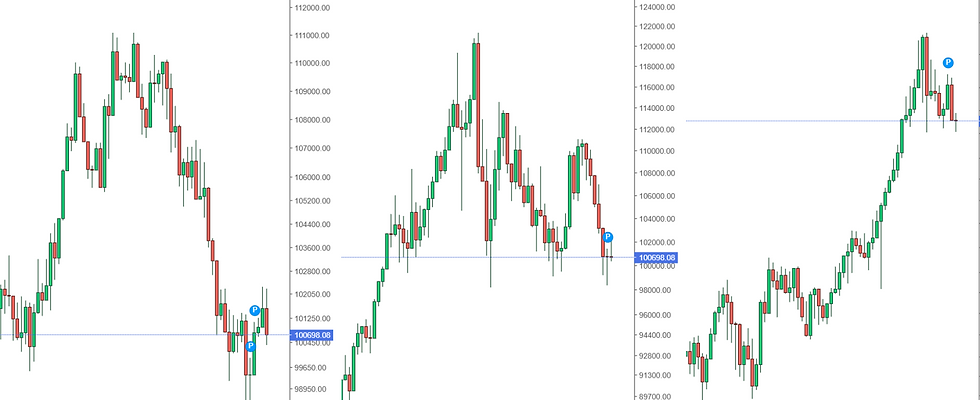
READY TO TRADE: ACTIONABLE AREAS: For active traders who look to generate cash flow on a continuous basis, determining the ‘next best probability’ level to execute against may be of immense value. The blue and red horizontal lines on the chart represent a next best probability buy re-entry range and a next best probability sell re-entry range over the short term. The ranges assume no existing position being held by a trader while the probabilities are based on several factors which may include: short term rating, medium term regime, momentum, horizontal or diagonal support/resistance, candle structure, moving averages and standard deviation, among others. These are short term levels and may be in contrast to medium and long term outlooks which are based on the weekly and monthly charts and, which may be applicable to long term investors. These levels are subject to change based on sentiment, the subsequent price action and company/sector specific or macro news flow. As always, while the levels are outlined, traders should be prepared to adjust in real-time based on the aforementioned.
"Strategy Alerts" help clients identify trading opportunities. When a ticker's real-time or pre-market price action aligns with the criteria on a slide—such as a pullback to the 21-day EMA or a breakout from a consolidation base—it effectively "matches" that stock to the strategy, triggering an alert to a potential trading opportunity. This approach transforms the playbook into a dynamic scanning tool, allowing you to instantly categorize active stocks by the specific technical thesis playing out, ensuring that every trading potential opportunity communicated is backed by a predefined, actionable setup.
THE TACTICAL TRADING GUIDE (PRICE ACTION MODEL): UNCOVER OPPORTUNITIES & ASSESS REWARD-TO-RISK
It helps helps clients determine and shed light on the some of the following:
The CURRENT TECHNICAL POSITION and a PRICE ACTION PROBABILITY for multiple time frames.
Three (3) ‘trading’ time frames are considered: Short Term (1 to 10 days) / Medium Term (2 to 4 weeks) and Long Term (5 to 8 weeks)
Whether the reward-to-risk is attractive for a buy/long position
Whether a share is weak. In this case, wait until the price stabilizes before looking to enter (i.e. want until it stops going down)
Whether aggressive buying is underway. In this case, do not ‘chase’ (do not buy) but instead wait for a pullback to re-enter a buy or an overextension with deteriorating candle structure to sell/short.
Whether a trader can look to buy a pullback into a key moving average (continuation trade)
Whether a share needs to break a range for a new trend to be determined (bullish or bearish)
Whether a traders needs to monitor for a change of character that could lead to a bullish or bearish reversal
Whether a share could start a consolidation phase or before continuing it’s bullish or bearish trend
Whether the upward momentum is slowing (if it's in a bullish phase)
Whether buyers can look to 'phase in' to a position (if it's in a bearish phase)
Whether a share lacks directional bias.
The data set is available in real-time (on request)
The readings are subject to change as the price action develops.
Lester Davids
Senior Investment Analyst: Unum Capital


Comments